Astrochemistry: Optical Properties of Astrophysical Ices
Topics: Astronomy, Astrochemistry, Fresnel optics & analysis, Cryogenic technology, Vacuum technology, Engineering & Machining
The Problem
Dense molecular clouds are accumulations of dust and gases, typically formed from the remnants of supernovae. Their density shields their interior from radiant energy and allows it to cool down to 10 K through blackbody emission. At this temperature the nanometer-sized dust is coated in ice: any frozen volatile, by astronomical definition. The massive success of the James Webb Space Telescope (Webb) has created something of a logjam in the world of infrared spectroscopy. There is a huge amount of data available in the infrared, but interpretation is exceptionally hard.
The Solution
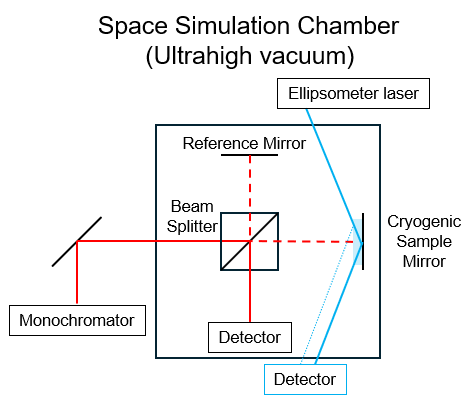
Optical properties of thin films can be measured easily with an ellipsometer when the sample can be handled in air. This is a more challenging operation when the samples are housed in a space simulation chamber maintaining extremely low pressure and temperature. To address these concerns, the Marks Lab is constructing a specialized instrument that will house optical access for simultaneous ellipsometry measurements with fixed-frequency lasers and a prism-based Michelson interferometer. This project is composed of numerous smaller projects that must be researched and prototyped in the lab to ensure their smooth integration. For example, compressed helium cryocoolers are extremely noisy and vibrate continuously, so the optical systems will need to be vibrationally isolated.
Space-Simulation Chamber
An extremely clean chamber pumped with a turbomolecular pump and an oil-free backing pump is a necessity for this experiment. A major challenge will be integrating liquid nitrogen cooling into the vacuum chamber.
Michelson Interferometer
The interferometer is not itself a complex device, comprising only a beam splitter and two mirrors at its core, but it will need to be carefully tested to verify it works long before installation in the chamber. Data analysis will be complex and will ultimately require a position-sensitive detector (camera).
Ellipsometer
Figure 1 shows only a simplified ellipsometer; the actual system will use a series of diode lasers combined into a single beam through a prism. The combined beam then follows the path labelled in light blue in Figure 1. Detection relies on measuring the transmitted intensity and polarization state of the light and analyzing them through Fresnel’s equations.
Spectroscopy
Initial setup will be done using visible light for ease of operation. Once the optical system is in the vacuum chamber and cooled to cryogenic temperatures, measuring the wavelength-dependent optical properties of frozen materials is simple in the visible and ultraviolet ranges. Once we know it works, we will move on to infrared spectroscopy of these ices.
Radiochemistry: Ligand Structure and Reactions on Actinide Surfaces
Topics: Radiochemistry, f orbitals, Dative bonding, Computations, Heterogeneous chemistry, Laser ablation, Non-linear optics, Mass spectrometry
The Problem
In early actinides the effects of relativistic contraction on d and f orbitals differ, leading to their mixing and extreme flexibility in electronic structure and oxidation state. The four-fold symmetry presented by the f orbitals grants actinide complexes unique modes of bonding and geometries. These unique properties make actinides prime candidates for the development of new catalysts. It remains exceedingly difficult to safely study these compounds with many bench-top techniques because of their radioactivity, toxicity, and reactivity. Accessing the lower oxidation states of actinides, i.e., 1+ and 2+ cations, is a tremendous challenge in condensed-phase chemistry.
The Solution
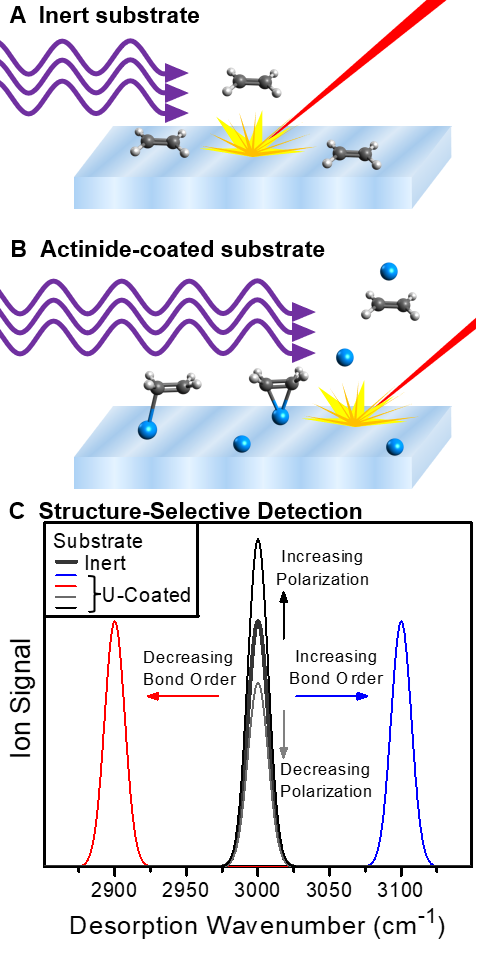
The sensitivity of laser ablation paired with mass spectrometry allows this technique to identify chemical reactions with only trace reactants present. Laser ablation with tunable infrared light permits reacting material to be sampled at any temperature and in any transmissive environment. Reactants deposited onto the surface at low temperatures will bind to both the substrate and the actinide being studied. Anything from chemical reaction products to changes in conformation upon attachment to the surface will be easily detected with IR laser desorption by a shift in the absorbing wavelength. IR desorption spectra will be used to investigate the effect of the actinide-bearing surface on reactant adsorption and reactions.
To begin this exploratory research, we first need a functional laser-desorption mass spectrometer, which can then be interfaced to any number of lasers or ion sources. This can be used to readily produce actinides in the low oxidation states that are most difficult to study in the condensed phase.
Reflectron Time-of-Flight Mass Spectrometer (ReToF-MS)
These mass spectrometers need to be disassembled, cleaned, and reassembled. Specific materials are not acceptable in ultrahigh vacuum chambers, and some modification is necessary for building a new mass spectrometer.
High-Voltage Power Supply
A ReToF-MS requires very simple input to use. Four power supplies producing up to 5 kV are needed to power the ion accelerator and reflectron. Careful handling of the components, and especially the cables, is critical to preventing high-voltage short circuits down the line.
Desorption Lasers
Initial desorption can be accomplished with small bench-top lasers that need some work done on them. Due to safety concerns and the time required, handling the pulsed lasers is reserved for graduate students. Many donated lasers are fully functional, and a long-term project available to graduate students is to develop a home-made pulsed infrared laser for this purpose.